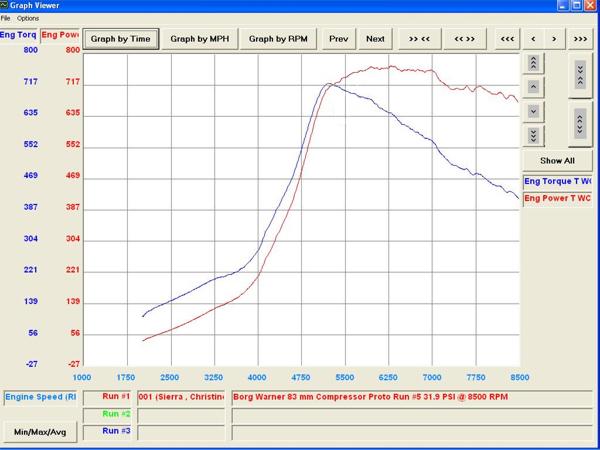
Mal was aus nem amerikanischen Forum. Kann leider nicht sagen welches. Habs mal ausm RS-Quattro-Forum rauskopiert.
=====================================================================================
Before I made time to dyno my car with the new actuator, I did some road testing and while this isn't an exact test, it does show how much more responsive the EFR is compared to the Garrett GTX. IF you look at this 2 second window comparing the GTX3076R w/.82 to the EFR7670 w/83, both reached the same boost level at the same time, but the EFR was floored about .5seconds later and about 200-300RPM later. This is a great example of the light weight CHRA coming into play.
In this diagram the Green line is a run on the GTX, and the red line is the one done on the EFR. You can see the sharp vertical line that represents throttle position. You can see how the EFR was floored later.
I did some other road comparisons and I was getting excited to see how this performed on the dyno. On the road, with the new high pressure actuator installed, I was noticing that the EFR was much snappier feeling. Cruising at 3000, I would floor it and it really felt alive as the boost started building. This is different compared to the GT or GTX3076 turbo, which turbos have much less response off throttle, and also at those lower RPM full throttle areas where the turbo is building boost. But when they come on boost, they hit pretty hard which makes them feel fast.
If a turbo feels fast that doesn't mean its really that fast right??
That is one of those things that is hard to describe to customers when talking about turbos. I hear customers say they were in their friends GT35 powered car and it felt so fast. It was because of that huge lag then huge hit of power. This makes cars feel faster than they really are. The reason why I mention that is the EFR actually doesn't have that huge hit power on the road like the GT turbos, especially the GT35.
Its like saying a Z06 Corvette feels slow compared to Rotated turbo kit STI. I have driven them back to back and the Vette with the flat TQ and linear HP curve actually feels slower, until you look at the speedo! This is the same with the EFR. On full throttle 2-4th gear runs, it doesn't have that huge hit of power, but when you look at the speedo you realize it's time to hit the brakes all of a sudden.
So, that is how I "Feel" about the EFR7670 with high pressure canister so far, not knowing how the EFR spools on the dyno. Until this point I had only dynoed the EFR7670 w/.83 with the medium canister and found it was slower spooling than the GTX3076R w/.82 housing by about 400RPM.
Hot Headers and Cold Headers
Below is a graph showing hot and cold runs. This is an important thing to understand because hot headers versus cold headers, makes a huge difference when the turbo spools up. The EFR7670 is the red and yellow lines from one set of runs at 25psi, and the green and blue are a set from the GTX3076. I consider the cold runs to be typical tuning runs where a run is made, a few things may be adjusted, and 30 seconds to 1 minute later another run is done. During this time, the header cools off as well as the turbine housing. A hot run I consider when a second run is done 10seconds or so after a run. During this time the header is still plenty hot as well as the turbine housing. The reason why it spools the turbo faster is that less of the exhaust energy/heat gets sucked out of cold headers which slows down exhaust velocity. When they are already hot, that energy/heat stays in the tubing and the exhaust velocity stays the same. The header on this car is not wrapped but wrapping would help this out between runs. This is also the same un wrapped header as used on the GT/GTX test so it a valid test as far as that goes.

If we use the 20psi mark, you can see that the EFR7670 with cool header crosses that point at just past 4000. But when hot, the change is pretty significant and decreases the spool point just past 3750. That is a 250RPM increase. The GT or GTX when cold was hitting 20psi at 3750,and when hot it would only decrease this RPM about 125 RPM. Either way all runs shown from here on out are done with the GTX or GT turbos with a cool header as well as the EFR with a cool header. All these runs
Before we start with the dynos let talk about the car, the dyno and all that stuff. I am sure many have see our GTX vs GT testing we did and while that info is still the same I know, not all of you, know about the car or dyno. So here we go.
The Car and The Setup
My 08 STI was used for these tests and its setup like a typical PERRIN GT rotated turbo kit car would be.
Parts installed: PERRIN Headers, PERRIN EFR Turbo kit, PERRIN FMIC, PERRIN Catback, and our PWI-2 Methanol Injection kit, PERRIN EBCS Pro, Deatchwerks 850cc injectors and Walbro 255lph pump. The engine is built with Cosworth Rods, Pistons and bearings, and ARP Studs. Things to take special notes on are: Stock heads, Stock Cams, OEM head gaskets, OEM TGV housings in place and functioning and stock fuel rails with PERRIN Stumble fix installed.
We use 92 ocatane fuel here in Oregon, but like any big power car running on pump gas, we run 50/50 methanol. The kit is setup to flow around 800cc's per minute. But can go up to 1200cc's.
Tuning duties are controlled by a Cosworth ECPro standalone ECU. An Innovate Wide Band, and EGT is integrated into the ECU as well as into the dash so i can visually watch AFR along with logging it.
The Dyno
Setup: Dyno we are using is our awesome Dynapack Dyno. Car is setup to run in 4th gear, starting at 2000 RPM and ending at 6900RPM. We use a settle time of 4 seconds, which means, the dyno holds the RPMS at 2000RPM for 4 seconds before the run starts. During these 4 seconds, we have the car at 100% throttle for about 2-3 seconds. The fans we use are not super crazy fans that flow 100MPH wind, but each fan flows exactly 28MPH (measured with our anemometer) and both are aimed at (not on) the intercooler). This doesn't provide perfect airflow to the intercooler compared to driving on the street, but it does provide very accurate and repeatable results and if anything lower HP that you may see on the road. Since the dyno has a pretty heavy load, it does provide pretty much the ultimate RPM for which a turbo will spool. So in these tests you will see ZERO benefit from the Titanium Aluminide Turbine wheel. Also all dyno readings are in Wheel HP not flywheel. Stock STI's make about 230-240WHP on our dyno as a reference.
All runs were done with the ECU reading about 30C intake temps, and this was very consistent. The dyno temp measured 60-65F. The dyno runs were done with about the same amount of time between them as well as coolant temps were always at 90C. The idea is we did it consistently to eliminate as many variables as possible. These same exact things were done with the GTX and GT tests a few weeks back and of course we did it on the EFR to ensure that the results were the same.
Tuning
Regarding the tuning. Like the other GT/GTX tests, I tried not to do any tuning beyond AFR. I of course tuned for boost to be able to match the same 1.2 bar, 1.5bar, 1.7bar and 1.9bar runs I did with the GTX test. For sure the AFR needed tuning between these turbos and in fact I found that I needed to add fuel compared to previous runs. But I started with the same ignition timing as used on the other tests. The idea is to ensure that no unfair tuning was done to increase HP or TQ beyond a normal level. Keep in mind the whole idea here is that these are tests for PERRIN to determine if the EFR turbo is something we are interested in making kits for. There is no reason for us to fudge results, or make one turbo look better than the other.
Engine Demand
On last thing to hit on is, engine demand. Using engine airflow calculators, or the Borg Warner Matchbot program, you can see what your engine requires for air flow for a given boost level and redline. The next thing to look at is if a turbo fits these demands and if it does it efficiently. If you compare this against some of the popular turbo upgrades you will see that in most cases customers are running off the compressor map but getting great power. So its not always 100% important that your engine airflow needs fit within the boundary of the turbos compressor map. Far too often I get calls from customers that look way to deep into this and try to match their power goals to perfectly on the compressor map.
EFR7670 vs GT3076R
This is the turbo that BW said it compared to the most, but should make more power. After the first few pulls I noticed that I was getting a bit more engine noise that previously. I ended up pulling timing around the 5500-6000 range to keep some of the noise down. In the end this didn't change power at all. First let's compare the GT3076R w/.82 housing. In this test you can see the EFR is slower spooling on the dyno. Keep in mind these are cool runs and hot runs were faster spooling as well as heavy load on the road showed better performance, but none the less its consistent.

The green line shows the GT3076r w/.82 housing making more TQ at 4000 because it was making more boost there., but as soon as the EFR and the GT cross the same boost path the more efficient compressor wheel starts to kick in. Even at 1.7 bar of boost the EFR was showing a pretty solid 20WHP gain over the GT. In this case it's easy to see that the slightly laggier nature of the EFR was worth the trade off in HP. The "Area Under the Curve" the EFR has, outweighs the GT easily. I feel this is the best boost (1.7bar/25psi) to test all these turbos at because this is a very common boost run on Subaru's. Of course you see more, but when it comes down to boost being used on the street, 25psi or less is pretty common.

Now on to the comparison of the 1.9 bar runs. Even at 1.7bar, the GT3076R is running out of in relationship to the compressor map, but at 1.9 it really starts to. I remember in previous dyno runs with the GT, I had to pull timing out to ensure it was ok. With the EFR, it was way happier. As you can see, its making 20-30 more WHP at the same boost. There is only one thing with the GT3076 run, it's that it was on the hotter side of things and it was spooling faster than the other. For some reason when I did the 1.9bar GT runs, I spent the first few runs dialing in boost and this purple line ended up being on the hotter side of things. Either way you get the idea on HP gained, and from the other results you will get and idea on the spool.
I did do the other 1.2 bar and 1.5 bar runs but no need to show you the same basic gains of about 20WHP.
EFR7670 vs. GTX3076R
As I had shown before the GTX turbos spool the same as the GT turbos. So its not a question if GTX is going to spool faster than the EFR, it's a question of how much power will the GTX3076R w/.82 make. As I had show the GTX3076 made about 20WHP over the GT3076 and you can see here that it's still not quite enough to overcome the EFR7670 HP. Looking at the purple line showing 1.5 bar of boost, you can see a bump in power at 4000, but that is where the EFR was running a bit more boost than it was supposed to. Besides that you can see they make about the same power until redline. Why is that??
Below are the 1.7bar runs and it shows about the same thing. The GTX and EFR make very similar power until 6000 RPM where the EFR starts to pull away. The blue line in the below graphs shows also that the area under the curve on the EFR most likely outweighs the 250 RPM slower spooling. That and the fact on the street the EFR is more responsive between shifts but more on that later.

Now if you compare the EFR7670 compressor map to the GTX3076R compressor map you will see how the GTX is more efficient higher up on the pressure scale, but not by much. In the grand scheme of things a few points in efficiency here or there doesn't really matter. This could be why the GTX3076 and the EFR7670 both made similar power at this boost level. At this level both are starting to run out of air and become less efficient. During the EFR7670 tuning I ended up getting some engine noise that I felt needed some timing removed. No I never hear knock but I pulled .5 to 1 degree at 6000 as it just wasn't perfectly happy. Again trying to keep thing consistent I was not experiencing this on the GTX tests. I had a target for engine noise on these runs and it was being exceeded. This is a one of the logs, and you can see how I use the individual cylinder noise as a guide to what is going on.

This is one of the runs that you can see I got some spiking in engine noise. It crossed the threshold for knock (that I set) and it pulled timing. But anyway in keeping things consistent, and while this didn't loose power or cause audible knock, I lowered timing to keep things consistent between the GTX and EFR tests.
Some might come to the conclusion that this turbo is less efficient than the GTX which is why I got knock. Well yes and no. The compressor wheel is less efficient, but my Methanol injection masks a lot of that. But as the engine becomes more and more efficient, the combustion chamber also does. A more efficient combustion chamber typically has faster, more controlled flame burn rates. This in turn means you need less ignition timing to get the same peak cylinder pressure. Is this what was happening because of the freer flowing nature of the turbine housing and wheel?
And finally here is the 1.9 bar results still show great Wheel HP and 480WHP is nothing to complain about that is for sure. Keep in mind that If I remove my TGV's, maybe wrap the header, there is more power to be had for sure. Is there 500WHP to be had here?? I say yes on an engine with heads and cams, and with a higher redline.
Why is the turbo not making more power than the GTX3076r? Here is the compressor map for the EFR using my engine data plotted on it. You can see that at 7000 we are off the compressor map. This also is true for the GTX3076r and GT3582R. But still this is making great power and for sure there is more on tap with the use of race fuel, higher boost, heads, cams....
EFR7670 vs. GTX3582R
So now lets compare the GTX3582R to this turbo. First up is the GTX3582R w/.63 housing. In this case the EFR blows it out of the water. It spools the same but it makes about 20more WHP everywhere. This is because the EFR has a much freer flowing exhaust housing/turbine wheel. According to Garrett's site this combo only has 22.5lbs/min of turbine flow capability. The EFR flows 24.5 lbs/min. That change in 2 lbs-min is 20WHP! So in this case the GTX3582R w/.63 housing is no longer a match for the EFR7670 with .83 housing. You can see below the blue line makes a lot more power everywhere.
I didn't put up the GTX3582R w/.63 and 1.9 bar as it shows the same thing. The EFR makes more power. But below you can see when we compare this to the GTX3582R with .82 housing, things start to change....
Now you can see this comparison look like the EFR7670 vs the GTX3076R, but this is the GTX3582R w/.82 vs the EFR7670 w/.83. If you think this is the more comparable turbo to the EFR7670, you would be correct. In this case, the EFR spools much faster and makes pretty much the same HP. At this 1.7 bar level, its obvious what turbo is best for you. Looking at the plot above, you can see at 1.9Bar of boost, the EFR efficiency starts to fall off at redline. Don't jump to conclusions that this is bad because GT3076 customers are constantly running WAY off the map. Here is a GT3076 compressor map plotted at different boost levels. Now don't forget I ran the GT3076 at all these levels and it made plenty of power.

Here is the GTX3076R with the same boost plotted and you can see how this matches pretty close to the EFR7670 where it just starts to run off the map at 1.9Bar and redline. Again we were running this off the map and it was still making lots of HP, so its not bad to run it off the map necessarily.
One more comparison is the GTX3582R w/,82 AR. You can see that the GTX compressor map is much more efficient at these boost and RPM levels compared to the EFR7670. But really the GTX3582 compares closer to the EFR8374 but we are not testing that turbo here, but soon! But this graph is more for comparison purposes and may explain why the GTX3582R made a tiny bit more power.
While the above graphs show the EFR7670 runs off the map at redline, and still makes great power. Check this out!
The EFR being quite a bit smaller than the GT3582R (in the compressor map department) it easily holds it own with the GTX3582. The faster spooling nature the fact it easily keeps up until 6000, I say the EFR7670 is worth a measly loss of 15WHP. Also during these tuning sessions, I had pulled some timing from the map because I was getting some increased engine noise as I was during the 1.7bar runs. I suspect that had the runs been done with race fuel, I would guess that the spread in HP would have been almost nothing. But as I said before, these tests were done to represent what most customers do with their cars.
And I bet that if I did a drag race with both the faster respooling nature of the EFR is going to make it a faster car. If you are running to 8000rpm or a lot more boost, then the GTX3582 comes into play, or the EFR8374. But in this case the EFR7670 is versus the GTX3582R w/.82 I would still pick the EFR7670 as on the road, this turbo feels significantly faster off boost and also between shifts.
On the Dyno Conclusions
The EFR7670 is a turbo that I personally feel compares more like A GT3582R, but spools faster on the dyno (like a GT or GTX3582R w/.63Ar). Comparing the EFR7670 to a GTX3076, its slightly laggier, but that lag is a trade off for more power. Since the GTX3076R and EFR7670 have very similar compressor maps, the HP gained is do to the higher flowing turbine housing/wheel. Since the dyno is very controlled, and a high loaded run, in all these tests the super light Titanium Aluminide turbine wheel doesn't come into play at all. What this does show is the turbine wheel and compressor wheel design is a notch up over the Garrett GTX stuff. From what I have seen Borg Warner has designed a turbo that does what they say it should. It makes more power and spools faster than the GT3582R.
On the Road Conclusions
My conclusions are this. The dyno conclusions do not match what I "feel" on the road. On the road, I feel like this is much more lively than the GT or GTX3076R. Its interesting as in some road tests the EFR7670 shows the same spool up RPM as the GTX3076 w.82ar, but it feels so much snappier between shifts light load low RPM shifts. Meaning the normal day to day 2000-4000RPM shifting is about 50% better than it was before. In some logs I notice that the GTX would show say 2-3psi of boost at these really low RPM's, where the EFR is showing about 5psi. Its only a couple PSI but that makes huge difference in how it feels. You can see this on the dyno graphs where the EFR is making more TQ at 2000-2500.
Under full throttle high RPM acceleration, again the car feels a bit faster. It feels like Its right back on the power. When comparing this to the GTX3582R graphs I have, it blows it out of the water. When comparing it to the GTX3076, its very close in respool time, but there is this thing that just "feels" better.
I am compiling some road going plots of the GTX3076R and EFR and I think this will show what I am feeling.
Final Conclusions
I used to think that there are lots of turbos out there, depending on the size of the turbine, its going to spool at a particular RPM, depending on the compressor wheel used, your redline and boost, its going to make a given HP. So then it was a matter of what size wheels Garrett and others used to create a given turbo and it was a balancing act of spool and HP. But Borg Warner has proven that there is some magic left in its turbos in that it actually spools faster than its comparable GTX/GT3582R turbo and makes almost the same power, if not more on the GT3582R.
PERRIN Performance will hold off on making conclusions about the entire EFR line when we are able to test an EFR7064 and the 8374. After seeing when these spool up, and the HP they make, I think we and other customers can decide if the EFR is here to stay. What I suspect is that the other EFR turbos are going perform better in one way or another to the Garrett product but will fall in between Garret part numbers in some way. That is not bad as it will make for a big balancing act of price, spool, HP, durability, features and feel.
What is next? I am going to beg and beg to get a test EFR 7064 turbo and in the mean time, I should have the test 8374 turbo from Full-Race any day and that will be bolted on and dynoed. I think this turbo will make more power, but I hate to say, I am not going to be running it high enough boost or high enough redline to really see where it kicks butt. For these tests I will be dynoing it purely to see when it builds boost. I will do the 1.7bar and 1.9 bar runs just for fun, but its not going to be making that much more power.....right???
Over the last couple of weeks I have been asked: Are we giving up on Garrett? No way! These turbos are very well proven and while they sometimes have a bad name in the quality department, I can say over the last 2 years we have had 3 warranty issues come up. Relative to how many we have sold, that % is very very low. I see that they will always have their place and customers will always want a Garrett turbo with an external wastegate.
Lots of fun stuff to come over the next few months!
EFR 8374
2.2l Evo IX mit Twin Scroll EFR 8374 (700 ft/lb (= 950NM) bei 5000 upm@32 psi = 2,2 bar)
EFR 6758
EFR 6758 auf Chevy Cobalt SS (2l Motor mit 2,4 bar LD und E85)